The Art of Disclosure
An interview with Prasanthi Ram
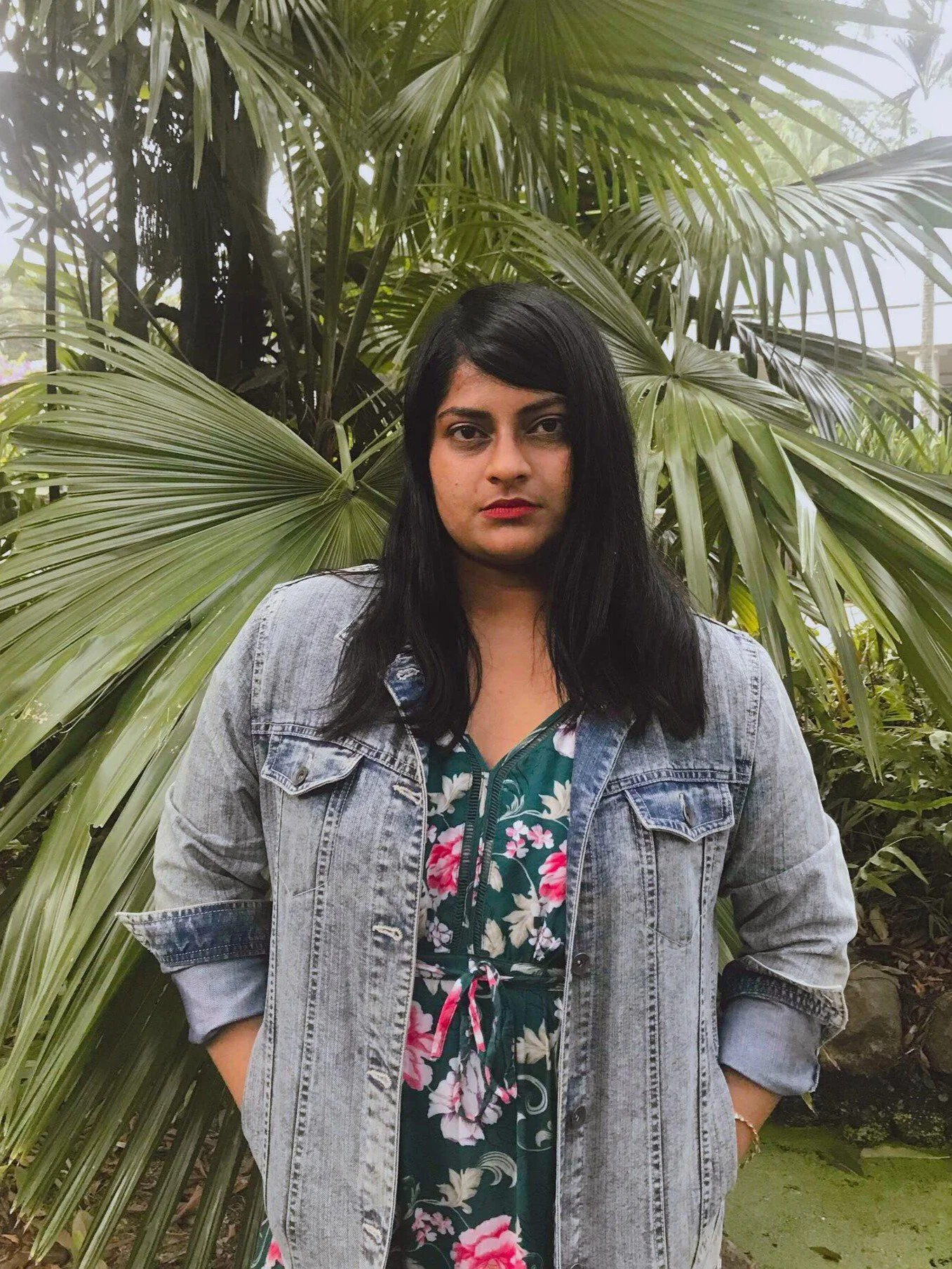
Prasanthi Ram is a writer, lecturer and editor. Her debut work of fiction Nine Yard Sarees (Ethos Books; 2023) was awarded the 2024 Singapore Literature Prize in English Fiction. Currently, she teaches writing, and is working on her second novel on ageing and care.
What we discussed
‘A Temporary Matter’ (1998) by Jhumpa Lahiri, also published in Interpreter of Maladies (1999)
Theophilus: So, we were just talking about having spaces to talk about craft – and I think this is a good point to bring our readers in. Why is this important to you, and what does craft and ‘making’ mean to you as a writer?
Prasanthi: It’s important that a writer has an intention to begin with. I believe this becomes possible when you have a keen sense of what craft can look like, and more specifically, what your craft can be. In other words, a good grasp of craft makes for clearer intentions––and this is what ‘making’ means to me as a writer. I wrote Nine Yard Sarees when doing my PhD, and many of my philosophies around craft came from reading very widely, to see where I aligned or didn’t align with other authors. This made me much more confident in the work I was going to put out, because there was a sense of where I was headed.
T: Where would you say you were at the start of that journey, versus where you are now in relation to other authors?
P: When I started the PhD I was only familiar with the novel, or the short story collection, so even learning that short stories could be linked in a larger work like a cycle completely changed my view of what fiction could look like. After that, I couldn’t look back to the novel any more. It made so much more sense to give my characters their own democratic space to be themselves, and see where they overlapped. This is much more reflective of real life, where we are all our own people, but also intersect or conflict. I also read authors like Jhumpa Lahiri, Balli Kaur Jaswal, Chitra Banerjee Divakaruni and Han Kang, who all have such distinct styles that helped me realise how I wanted to write.
T: It seems that in a novel the world-building is much more singular and cohesive, but in a cycle it takes place in a much more fragmentary way. What do you have to be aware of when putting a cycle together?
P: You first have to be comfortable with gaps. A lot of us have been taught to close any gaps we see in our stories, because that supposedly makes the writing more effective. In a short story cycle, however, you need to know how to use these gaps for a certain effect too. For example, since Nine Yard Sareesis about family, I reflected on my own family during the writing process and realised that we often had different understandings of the same events. These different versions don’t make our individual understandings any less true for us; they are simply multiple truths that co-exist. It made sense to reflect this idea in the work because it aligned very naturally with the inherent gaps of a cycle.
You also have to accept the fact that readers might be uncomfortable. Because readers are often going to want closure. So understanding that you’re not going to satisfy a reader in the traditional way, is something I would advise anyone who opts to write a cycle to be prepared for.
T: What do you think is the source of readers’ discomfort with the form? You mentioned ‘closure’––is there the sense also of losing the omniscience of the traditional narrator?
P: Yes, we don’t like cognitive dissonance. We don’t like feeling like things don’t add up. But if we reflect on our lives, we realise that a lot of things just happen because. Maybe my book is a way for readers to start confronting that discomfort with seeming incoherence.
T: You spoke about the importance of learning to use gaps in the story. In my own writing as a poet, silence and the space of the page is also very important. How is silence, or gaps of time and space, wielded deliberately in your book?
P: There are certain characters who begin one way and end in another. If it were a novel, I would have felt much more pressure to show that arc clearly, whereas with the short story cycle you have some liberty. The reader is going to be aware, after a few stories, that there are going to be gaps in space-time. I can use that to my advantage because I can skip forward and say, now this is a completely different person, but leave it up to the reader to imagine how they are the same character.
For example, if you were to meet Padma’s husband Srinivasan in the earlier stories versus the final story, or even one written by his wife versus his daughter, you would find two completely different accounts of the same man. I like the fact that the onus then lies on the reader rather than myself. In some sense it could be read as a cop-out [laughs], but it also enables a much more active process of reading. When I read, I like making up my own choices about what has happened. Like in the Jhumpa Lahiri story we’re going to talk about later, it’s an ambiguous ending––we don’t actually know what happens, and I like that.
T: That’s interesting, to think about the reader’s work as well. It’s not just for the reader to discover thingsbut to decide things. I did notice that earlier in your book, some of the stories are spaced further apart, but towards the end you have a cluster of stories all set in 2019. Now that we’ve talked a bit about gaps in the narrative, how do you decide when to take these gaps away?
P: I guess I’m a little bit of a liar! While I did say I enjoy the gaps thoroughly, I also started feeling uncomfortable with the fact that none of the stories were converging even marginally. That’s where I started considering if I could create multiple stories in a similar time and space, yet show family members at different stages of life. You could get an even more intimate snapshot of the family that way, and how those dynamics clash or intersect with each other.
This is my own way of negotiating with the cycle. Because despite my original resolve, I realised there was only so much in terms of gaps that I could tolerate as a writer. Part of the work is then figuring out how much of the gaps you want to close, and how much to leave open. It is a balancing act between the two, in response to your own comfort or tolerance level as the creator.
T: You mentioned at the start that this journey has involved learning to write about your own experience, your own life stories. In this book, most of the characters are from the same community, but there’s one who’s more obviously an outsider, Fiona, who’s Krishnan’s Korean-Australian partner. How did you think about the outsider’s perspective?
P: There are other outsiders to the community too. Sivagami, who’s a domestic helper that works for the Srinivasans, and Mira, who is a globetrotting photographer that encounters Vani, the youngest cousin in the family.
From the get-go, when you choose to write about a community, there’s always a danger of it becoming quite insular––and especially when writing about a privileged caste community, it would not have been right to only cover perspectives from within. This is why I wanted outsider characters to resist or contradict, to create some sort of tension, or even compel re-readings of the characters we already know and the ideas they hold.
T: These outsiders illuminate certain aspects of community and in a way, they stand for those of us who encounter this story also from the outside. We find our way in through them. What sort of reception have you received to a book in this form?
P: It surprised me that many readers were fine with the cycle form, and were excited to find patterns running through the stories. They liked that they could fill in the gaps themselves. Some told me that they would go back and forth between stories to try and match details, which they found to be fun. On the flip side, there were also readers who were clearly looking for a novel, even though the cover says “short story cycle”! I think they just hadn’t been exposed to the form before, and didn’t know that they would have to contend with gaps. Hence, the book never quite succeeded in their eyes. When I come across such comments, it’s more a reflection of the reader’s expectations of what fiction can or should do, and I’m happy to be the person to prompt them to reflect on why it is that they have such expectations in the first place.
I’ve also had interesting responses to a section in the book containing letters between Raji and her two daughters, where a pencil sketch of a bird appears. Quite a few readers came up to me and said the sketch made the letters feel so real. As if they were actually touching something that Raji had drawn herself.
T: And it’s a sketch by your mom!
P: It is! Before the book came out, I’d only looked at that section on a screen, so when someone first told me at the launch that they loved the tactile nature of the letters, I flipped open the book and realised for the first time that such elements do come across differently when the book becomes a physical artefact. That made the book feel new even to me.
T: We’ve spoken about your perspective as an author, but you’re also an editor at Mahogany Journal. How has inhabiting that role shaped you as a writer?
P: Being an editor has made me a better writer, because I’m not just learning about different writers’ styles and approaches to writing. I’m also learning how to convey what I might expect as a reader in a gentle way that doesn’t diminish my writers’ confidence but nourishes it, and supports their artistic vision.
Quite a few writers who submit to Mahogany write fantasy or speculative fiction too, which has inspired me to try writing in that genre someday. There’s so much magic in breaking the laws of reality, and I find this quite liberating. Nine Yard Sarees was steeped in the basics of real life, which is important to me as a writer, but it’s also interesting to see what you can learn about real life through fantasy.
T: Many of the authors you mentioned earlier are also realist writers. Do you have favourite speculative fiction writers as well?
P: I think I tend to watch more fantasy than I read. But many speculative fiction novels that I’ve read have tended to be Singaporean, like [Ng] Yi-Sheng or Nuraliah [Norasid]’s books, and I’ve found it so fascinating to see Singapore in a completely different light. In their books you find completely different languages (in The Gatekeeper) or even the end of Singapore itself (in Lion City) – it’s crazy that he could think so far ahead.
Internationally, Margaret Atwood is one of my favourite speculative fiction writers, and a lot of what she’s written has either happened, or is close to happening. I reckon these authors are closer to being the leaders of the fiction world than us realists.
T: Speaking of your touchstones––I think this is a good point to turn to the story you sent across for this interview, ‘A Temporary Matter’ by Jhumpa Lahiri. Why do you think of this as a good example of craft?
P: This story is, to me, the perfect rendering of the form. It is beautifully crafted, has a very clear intention, and exposes human dynamics in a poignant way. Lahiri is someone who seems to completely understand what it means to be human.
T: You’ve mentioned a couple of times this idea of intention. Would I be right to say that for you, intention comes across at the level of craft, in the sense that the function of craft is to make it clear to the reader what the writer’s intention is?
P: Yes. You can tell when a writer is just putting characters in a room and letting them go at it, where there’s no real goal at the end of the story. When I say ‘goal’, I don’t mean closure––I mean ‘goal’ as in, maybe wanting the reader to feel a particular emotion, or placing a magnifying glass over a certain relationship, as in this story. With Lahiri, every story has a clear goal that comes across in the craft. This is quite rare in my reading experience, as it is instead quite common for collections to have some stories that read more like ‘fillers’––the same way certain songs on an album leave more of an impression than others.
T: I read Interpreter of Maladies years ago, and picking up this story again, what came across was how, for Lahiri, relationships are premised on knowledge and disclosure, and when that breaks down the dynamics of the relationship changes. That’s also something I see in your book; the letters for instance are there as an act of disclosure, particularly to one daughter but not the other. Was this something you thought about, in relation to Lahiri’s work and your own?
P: That’s such a compliment! When I was writing Nine Yard Sarees, I found it quite important to know what secrets each character was keeping, and how much of their secrets would eventually be revealed to someone else, even if that someone is only the reader. There are different degrees of disclosure too. Some people reveal their secrets to lovers, some never really reveal it to anyone but themselves. I think that’s what makes human dynamics very complicated, because you never quite know where you are with someone else. You never really know what they’re holding back.
T: With characters who are much more withheld, versus those who are ‘oversharers’––how do you balance out readers’ relationships with them?
P: The character I practiced this most on was Padma, who never confesses her true feelings to anyone else. The way I revealed her secrets, or at least a hint of a secret, was through her internal dialogue. One of the craft philosophies I came up with when working on this book was that our actions don’t always align with our thoughts, which can be used to the story’s advantage. Padma thinks she’s a wonderful mother and she’s doing her best. In reality, what she says or does to her child is very hurtful, and that contradiction or irony works on the page as it would be familiar to anyone reading the book because they have probably been at the receiving end of this, or are guilty themselves of not aligning with their thoughts––or actions.
T: Something else that came across to me was the lucidity of Lahiri’s writing; how simple and effective each sentence is, it feels like she’s just putting an array of facts in front of you––
P: ––and yet it creates a story! I think that’s true. What I admire the most about Lahiri, which I’ve struggled with myself, is restraint. Earlier I said that each character withholds or exposes their own secrets, which means I have to be in charge of deciding when to dial it up, and when to turn it down a notch. It can be tempting sometimes to just tell my reader everything. So every time I go back to Lahiri, someone who plays with silence and restraint so well, I’m reminded that so much can be said with so little. ‘Show, not tell’: she’s a master of that. Even though she tells us a lot, she decides when to tell us things to create certain effects, and that’s not an easy thing to do.
T: You’ve also mentioned that Lahiri has written interlinked short stories elsewhere. What were some of the things about her cycle that you tried to learn from or picked up on?
P: Lahiri’s Unaccustomed Earthhas two parts––the first with standalone stories, and the second titled ‘Hema and Kaushik’, who are the two characters explored in three linked stories there. When I first picked up the book, I had no idea that these stories would be linked, and I thought it was odd that she would divide the book in the two parts. Then I started the first story and loved it, and went on to realise that the second story was a continuation of the first, which made me love it even more, because now I had two viewpoints––not opposing ones, just two perspectives of the same dynamic. Then you get to the third story where the narratives converge, and it was the most exciting thing I’d ever read. I kept thinking these stories could be a novel on their own; but each story could also stand alone. I remember feeling that excitement and thinking, Why not transform it into a full-blown cycle? That’s what I wanted to recreate, that feeling of seeing connections emerging where I didn’t expect any.
T: Did you start this project by mapping out all those connections first, or just write the first few stories and see where they went?
P: I had a core set of characters whom I decided to write first, then I waited to see who else would emerge in the storytelling. In a story cycle about a family, a minor character, such as an aunt, might naturally pop up in the course of the narration. You might then think they could be interesting to explore, so you decide to write another story around them… I think it got to a certain point around the sixth or seventh story (there are eleven in total), when I started thinking more seriously about missing perspectives. That was more of a macro assessment to see who I was putting on the page and why, and whether there were voices that were absent but should be present in such a book.
Someone like Shweta, the aunt, was a very last-minute addition. I had no idea she would be in the book, but I was kind of offended when I realised she wasn’t. Why didn’t I think of her earlier? She made so much sense at the very end.
T: How did you know then when the book was complete – after bringing in characters like Shweta – and not to add any more?
P: Well, the deadline was coming! But also, I had already been thinking of a broad arc, where the landing-point would be Keerthana’s wedding. So deciding whether the book was complete was pretty much about seeing whether that arc was sketched not completely, but enough for the reader to be satisfied.
The letters were also a last-minute addition, because I felt that if I didn’t explain Raji’s headspace early enough, then the final part of the book wouldn’t be as impactful. By putting Raji’s revelations in early, the reader starts to anticipate her return. That’s where I decided that I needed the letters; after those were in, I knew the book was done.
T: There’s definitely the sense of an ending when we come to the penultimate story, which is set in the past, before flashing forwards to 2019 in the final one.
P: I always refer to that as the origin story, because I think with families there’s always a point at which it all makes sense, if you go back far enough.
T: Why did you put this origin story near the end––did you feel that your readers had to know a bit about everyone else, and how things panned out, before they encountered it?
P: I knew that the origin story was going to be the heart of the text emotionally, because it looks at something very dark, something that happens to many families––a daughter who dies too early. I didn’t think it would be sensible to put that at the start, because the first few stories were just easing the reader into the family. But obviously it wouldn’t be smart to end with it either, because the reader had to be brought back to the present day. So it ended up as the penultimate story.
T: I was prompted to ask this because in Lahiri’s story, the origin story there is that of the stillborn child, which we discover quite early on. Everything proceeds from that point.
P: That’s true. What’s interesting is that I misremembered that the reveal of the child dying in Lahiri’s story was at the very end. But when I read it again, I realised we already knew that the child had died, and that the important part of the secret was that Shukumar had held the child before the child was cremated. Which neither his wife, nor the reader, had known up till that point. I think what this teaches us is that there are layers to every secret, and you can ‘mislead’ your reader into thinking that they know everything, only to reveal that there was still a layer of information they were not privy to.
Another thing––when I read the end of the story again, where she switches the lights back off, I thought, are this couple in fact on their way to a mend? Or do we think they are done? What do you think?
T: Well, I thought they were done! I thought that when the lights were turned back off, and they both wept, they were mourning the relationship and the child.
P: I used to think that. But last night when I read it, maybe because I’m a much more hopeful person now, I thought––isn’t it interesting that at the very end of the story, they can finally be emotional with each other, after avoiding each other the entire duration of the narrative? Might that suggest that there is hope, that Shoba decides that she doesn’t actually want to move out after all?
T: To me, the turning on and off of the lights is very metaphorical in this story, where they can only access each other emotionally in darkness. But when the lights are on, they are back to reality.
P: I don’t think there is a wrong answer here. Do you expect a couple like this to find a way back to each other, or is it a final goodbye? As someone who has read this story more than once, I clearly have had different responses, and I am very excited by that. That Lahiri does not tell you what to think.
This aligns with my philosophy behind Nine Yard Sarees too––I’m not going to tell readers what to think about the characters, I’m just going to present an intimate character study and they can make up their minds.
T: That decision-making process also reveals something to the reader about themselves.
P: Yes. Not many readers realise that how they respond to a book can say much more about them than the writer.
T: Back to the idea of knowledge and disclosure, do you think family stories hinge especially on this? Are family relationships in particular illuminated by secrets in this way?
P: The thing about families is that people withhold information because they think it will hurt the other party; a parent decides not to tell their child, for instance, about a father’s infidelity, or a husband chooses not to reveal the gender of a stillborn baby… For myself, becoming an adult daughter has meant that my mother has become much more comfortable in sharing things about her marriage and family life. I’m often quite intrigued by families who are the opposite, where secrets are literally brought to the grave, because that probably means the surviving members have a skewed or incomplete understanding.
T: Pivoting a little now, you mentioned at the start of this conversation that you’d find it hard to go back to the novel form for this story. How about for future projects?
P: I’m working on a novel, but I always tell people that it’s a novel “for now”. I’m not sure if it will be one, at least in the traditional sense of having a central protagonist that carries you from start to end. I always think about form after thinking about story. I don’t impose a form first; clearly it didn’t work for the first book. But I feel that doing it this way allows the form to serve function a lot more effectively.
T: So story comes first, and form second––but how do you decide on story? Some writers talk about how stories come to them, while others go out and hunt for material.
P: Oh, I don’t. I don’t hunt [laughs]. It usually begins with an image, a feeling, or a piece of dialogue. When I say feeling, I mean the most intense emotion the story is meant to produce, whatever that is, and then I follow through. So while I’m not hunting or chasing after material, I am pursuing the inspiration and turning it into a narrative. There are moments where the feeling, image or dialogue that comes to me is the ending point––then I work towards it. Other times it feels like the midpoint, so I write around it. But I never quite write a story where I know the structure from start to end.
T: When in this process does your intention then become clear to you?
P: By and large, after my first two or three attempts at writing a story, i.e. nudging the inspiration along, I have a sense of what I want my story to do for me and for the reader. Usually it’s a question that I want my story to answer, for instance, will my character stay in a relationship? Or will my character realise she’s a horrible person? My intention becomes clear to me when that question emerges.
T: I think that’s a helpful way to think about it, even if the question doesn’t immediately have an answer.
P: It usually doesn’t. Even when I reach the end of a story, the question is never fully or definitively answered. But that’s the way I like it as a writer. As I mentioned earlier, I obsess over revealing truths, in my stories, and that includes not settling for a complete conclusion. Because the world tends to operate quite falsely on binaries, and we trick ourselves into thinking we must pick a singular answer, instead of realising that both sides of a binary or more can be true.
There’s a reading I assign to my students by Peter Elbow, and it’s titled ‘The Uses of Binary Thinking’ ––about how we often think in either/or, when the world operates on both/and. He suggests that the way to deal with binaries is not to resolve them, but to push the polar opposites in extreme directions to see where they go. He even says that sometimes, reframing the binary to hold more oppositions might be a stronger approach. I carry this idea with me as a writer––why do I have to pick one version when it can all be true?
T: With reality, there’s often a sort of Rashomon effect, right, where different perspectives illuminate different angles of truth. When did it become clear to you that literature could do this––could capture the both/and, rather than either/or?
P: I think just being in a classroom, and discussing any good piece of literature with a bunch of earnest, eager students. When I teach my students close reading, I often tell them that it’s an evidence-based practice, and that as long as they can prove why they feel a particular way about a story, I am willing to accept their reading. It’s interesting to me then when I read interpretations of a text that I never considered before but are sound, in that the evidence is in the language. That’s how I realised, as a student and now a teacher, that literature has that power to elicit various perspectives that can all be simultaneously true.
I wish the world were a bit more like this. I wish everyone had a humanities education, and could become more comfortable with alternate perspectives and truths. That’s what is lacking, I think. Especially now.
This interview was conducted for Making: A Scene in December 2025.
