Articles of Faith
An interview with Jerrold Yam
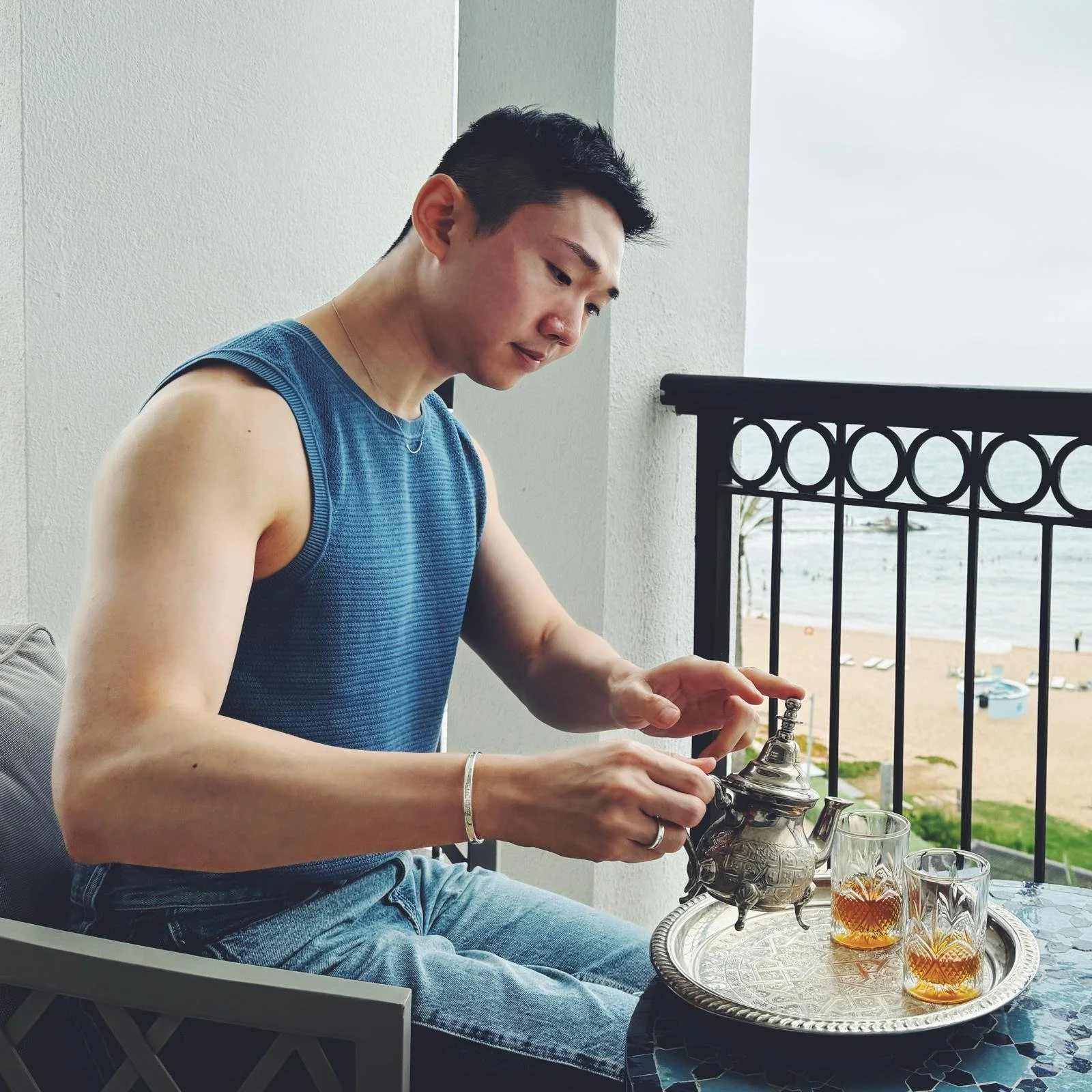
Jerrold Yam is the author of three poetry collections, including Intruder (Ethos Books). His poems have appeared in Poetry London, Magma, The Rialto, The London Magazine and Oxford Poetry. In 2024, he won the Cheltenham Poetry Prize and was shortlisted for the Bridport Prize, the Magma Pamphlet Competition and The London Magazine Poetry Prize. He was a 2024 Writer-in-Residence at the UK’s National Centre for Writing.
What we discussed
‘Moon, Sun, and All Things’ (2025) by Harry Josephine Giles
Theophilus: Let’s begin with a question I put to all the writers in this series – what does making mean to you?
Jerrold: It’s hard to find any sort of universal truth, but making for me denotes a sort of psychological space, as I think you have to be in the right sort of psychological position to want to create, or to be able to create. With our day jobs and social media, modern life inundates us with so many distractions that take us away from the making. Even after I’ve logged off from work, my mind could still be dithering on work commitments or deadlines, and that space often isn’t the most instinctive one to inhabit. But making, for me, means firstly to enter a psychological space of creating, as opposed to consuming.
On the practical side, you need to carve out time and set aside distractions, say, for the next two to three hours. Then I typically start with reading, normally for about 45 minutes, just books on my shelf, to get myself into that space and that conversation. Only then can I think about the actual act of making, moving from the thought of wanting to make something to actually doing it, which is where craft comes in.
T: It’s interesting that reading is such an immediate touchstone for you to prepare yourself to write. Do you often go for writers whom you feel an affinity to, or writers who challenge you and push you out of your comfort zone?
J: When I began writing, maybe thirteen or fourteen years ago, it would be writers who explored similar themes to me – they might execute those themes in different ways, but their preoccupations would largely be similar. But in the last five to six years, I’ve decided to read everything, without as much conscious curation. The ones I revisit just prior to writing are those that are extremely different, in both style and content, to what my work is.
I rarely come across a poem that I feel I can’t learn something from. The larger the disjuncture between what I’m reading and my own conception of what poetry is, the bigger the opportunity I find to bridge that gap. That’s also why I picked Harry Josephine Giles’s sequence for this conversation, because it’s not something that I would write myself. But there’s a lot I admire about her work, and this sequence in particular which is concrete poetry. There’s so much to draw from.
T: We’ll come back to Giles later in this conversation, but I wanted to ask more about this sea of material that you surround yourself with as you prepare to write. So much of your recent writing transforms other texts, including pieces of scripture, legal artefacts, or Mandopop lyrics. Are these also touchstones of yours, in addition to poetry? How do you approach the process of transforming them – not just drawing from them but working on them?
J: Zining said something in her interview for this series, that it’s the living that informs the making – we can talk about craft, but the lived experience counts for so much. For me, being a Christian, being a lawyer and, well, liking Mandopop have generated these sources of inspiration.
We count certain things among our inspirations because we lead our lives according to them. With the Bible, for instance, some would view it as setting out the pinnacle of virtue; the whole point is to try and walk in Jesus’s footsteps. Mandopop is such a commonplace accompaniment to our daily lives while on the legal side of things, law governs relationships between people. Just observing how different sorts of legal principles extend into the governance of our own personal relationships, for example with [Section] 377A, has been very instructive in my work. Interestingly, there’s a lot of poetry in scripture – the Psalms, for instance – and also a lot of religiosity in something like constitutional law, there’s that idea that this is how an ideal society should behave and how people should treat each other.
T: Law as an article of faith, right?
J: Exactly. The more I look into each of these sources, the more they seem to be bubbles that encase how we lead our lives. It’s probably impossible to extricate ourselves from these dogmas.
T: Taking this idea a little further then, does the opportunity to transform such foundational texts through poetry present itself to you as a way to reassert your agency over these articles of faith? Is that why you choose to intervene in the texts?
J: There are different reasons, I think. On my residency at the National Centre for Writing, my mentor Andrew McMillan made a comment that was not initially apparent to me, though now it seems so obvious. He said the poems where I respond to Biblical texts seem to hold their subject matter with much more reverence, compared to, say, the Mandopop sequence. With the Mandopop sequence, I’m transposing the song itself – the lyrics, music video, melody, or some other dimension – into an aspect of the writing persona, and learning to live out the songs if you will. But for the Biblical texts it’s about learning to live in them, and exploring the tensions and contradictions that such habitation would create.
Ultimately, I think it’s more of a reaffirmation because in all of these sequences, the writing persona belongs in the space created within this poem by those texts, though the way they’re treated may be different.
T: There’s certainly a balance of reverence and playfulness in these poems – the Mandopop ones have more whimsy, compared to the more doctrinaire legal and religious ones. This doesn’t make them more boring, but they have a different relation to their subject.
You observed earlier that there’s a lot of poetry in religious texts, and obviously in the lyrics of songs, etc. As a lyric poet yourself, do you think your lyricism feeds off the lyricism in these texts, or do you try and introduce a new approach to them? How do you engage with something that is already beautiful as lyric?
J: I’m continually inspired by the lyricism of these texts and sources, which is why they feature so strongly in my work. But I think the lyricism in law and scripture can come across as quite impersonal – the Bible, for instance, charts the journey of God’s people across history, their various trials and tribulations, the consequences of sin, and so on. And I think the individual story is, I wouldn’t say less important, but not the central focus of the grander narrative here, even if individual salvation is a theme.
The power of poetry is such that when I respond to these Biblical texts, poetic lyricism allows me to personalise something that is so overarching, by making a specific instance a microcosm of that discussion. There’s also room to explore and analyse how those overarching themes impact one’s life – for instance, writing from the position of a modern professional who’s gay – that adds to the discussion of these Biblical stories because it’s not immediately apparent that the writers had that sort of person in mind. I mean they had everyone in mind, for sure, but to make it specific to an experience and personalise it is quite powerful. Ironically, I feel that people who identify with those categories can then feel more affinity with those larger-than-life Biblical texts, so I see it as a bridge.
T: I can see that especially for the Biblical and legal texts. But I suppose even with Mandopop, which we usually encounter as young people and teenagers, it’s about connecting with those bigger themes of love and betrayal and jealousy that we may not fully grasp yet, but only start seeing our own lives playing out against them later on. I suppose that is the point of lyricism, to act as such a bridge.
J: Yes, absolutely.
T: Maybe to delve into the process side of things now. There are obviously things you want to say by transforming all this material. Do you begin, so to speak, with the text as you find it – or do you begin with what you want to say, then select the text to be moulded into the right ‘container’ for it?
J: It’s probably a bit of both. Sometimes I don’t know what I want to say until I’ve encountered the source material and something clicks. Other times, like in this collection I’m working on, I feel there is a gap – and I need to talk about this or that aspect more. In that case it’s driven internally, to look for some external source to bounce off. But I never know when a poem is finished until it’s actually finished, so there’s always quite an exciting journey.
T: While you use poetry to transform the material in the most immediate sense, I suppose that how you are changing as a person – the time that goes by as you absorb the material, your own shifting perspective – comes to act on the material as well. And maybe the writer’s ‘process’ refers to the sum total of all these transformations.
J: Unlike a piece of furniture, when can we say that a poem is actually finished? I don’t know.
One of the poems in the Mandopop series, written after a Tanya Chua song, was initially composed in blank verse – like most modern poetry – and it was only after the fifteenth or twentieth draft that I changed it into an abecedarian. The song itself was called ‘Aphasia’, after the medical condition where we lose our sense of speech or communication, and the poem talks about miscommunications that could happen between parent and child, and their implications. Revisiting the draft, I felt the abecedarian could best capture this, as a form that is so intrinsically tied to language itself and the articulation of meaning through language, by giving us a rubric, almost, in the alphabet. But this realisation only came later. I think when we make a poem, our thoughts and our intentions at that point could also deepen and mature as time progresses and this then leads to a more enriching editing process.
T: Tell us a bit about your editing process – fifteen to twenty drafts sounds like a lot! What are you looking out for when you edit?
J: It’s the vibes for me! [Laughs] Does every word feel like it’s where it needs to be? Does the structure of the poem feel right, do the line-breaks feel right? Does punctuation or the absence of punctuation feel right? Between drafts, I could be just changing punctuation from a comma to a full-stop – if I want something more impactful – or even a line-break. There’s no real tick-boxing, it’s just whether the poem makes sense on the level of its smallest divisible unit, at the level of the line.
T: Maybe to put this question a different way, when do you stop editing a poem?
J: I don’t think I do. I just come to a point where I’m comfortable with the poem being published, or at least comfortable with the poem existing on its own terms. Whether it’s published or not is secondary. Beyond that, I think it can always be improved, but at least the baseline is that I’m comfortable with its existence.
T: Maybe this is a good point for us to talk about the Giles poem you sent over. I’ve told you separately that I was surprised you picked this, it seems so different from your usual poetics. What aspect of this poem do you consider to be well-made?
J: This sequence deviates from traditional concrete poetry, which is often shape-based – it’s a bit reductive to say that, I know – but it’s often the case that the writer draws parallels between the content and the shape of the poem.
Here, there’s just one word per poem, and the word is broken into its constituent parts. The way the word is arranged mirrors the meaning we ascribe to that word in nature, and the meaning from this sequence comes from that dissolution and re-assemblage. I find this really interesting because it lands a tangible manifestation of what every poem does. Every poem breaks down meaning and reconstitutes it, even lyric poems.
This poem takes us on a journey, you know, we see the celestial bodies, the sun and the moon, where the O is an infinity sign, with implications of distance and unattainability. There’s a bit of whimsy as well; it’s quite hard to do humour in concrete poetry, but the bird here is lying parallel to the ground, and even the plane… it takes us on a journey in terms of form, from celestial bodies to animals, man-made things, symbols of production, symbols of capitalism, then back to nature. It ends where we began, which is also a celestial body, and it’s a star, with sort of the same placement as the sun at the start.
The other thing I like is the use of empty space, because – and again this is true of every poem at some level – but when we say we make something as a poet, it’s not just the words but the spaces we leave that also make meaning, that also contribute to the meaning made by the poem. I guess in the same way if we furnish a house, the spaces we leave unfurnished are as much by design as the ones we furnish.
T: This is a concrete poem in that it plays with space and visuals, but it also plays with sound, in that the letters removed from each word are the vowels, making you focus more on the consonants and the sounds they make. In your own writing, how do you think about the relationship between what is seen and what is heard?
J: The music of a poem is inextricable from its meaning. This is just part of my writing process, it’s not completely prescriptive such that I might look out especially for assonance or rhyme. In this new manuscript there are a few sonnets, for instance, and the decision to use those forms is motivated by the meaning that has been made in the poems themselves, and the music of some forms allows that meaning to shine a bit better. Coming back to your question – well, just vibes again! But also, what the meaning of the poems dictates.
T: With your Biblical poems, the verses they’re based on often appear in an epigraph; but in the Mandopop poems, the Chinese lyrics might appear in the body of the poem itself. Could you say a bit about how you are playing with what different groups of readers, fluent in different languages, might hear in your poems?
J: That was one of my key considerations in this sequence, actually. I mean, you could play it differently: you could not include Chinese lyrics and only have translated lyrics, you could not refer to the lyrics at all, or leave them at the start as an epigraph. But it was quite beautiful to me to have two language systems meeting on the page in a way that they might not normally in the Anglophone world. In that vein, a bilingual person would take away more than a person that understands either language on its own, but because I was trying to capture a certain aspect of Chinese Singaporean identity, where most of us are brought up bilingual. In a way I was aiming for an authentic portrayal of what the experience of language might be for them.
There are some poems in the sequence that deal with the interplay of multilingual influences differently. For instance, there are what I call mistranslations, where I translate the lyrics of that poem but with lots of poetic license, and it’s not an ‘accurate’ translation. Then there are also ‘accurate’ translations, but feeding into an imagined scenario based on what the song is about. Yet others don’t refer to the lyrics but are more inspired by the music videos of those Mandopop songs. I think the polyphony of these sounds is quite exciting to me. Quite early on someone asked, aren’t you afraid that meaning might be lost on both sides, depending on where you publish? But I think there are ways to let the poem stand on its own terms, retaining clarity. And who’s to say it’s not a good thing that different readers with different backgrounds and cultural influences come away from a poem and interpret it differently? After all, no two people really read any poem in the same way.
T: I guess it is the physical space of the page that forces these two language systems to meet and interact, like how the Giles sequence uses that space to play with both visuals and sounds. Has this made you think about experimenting with concrete poetry yourself?
J: Never say never! I’ve learnt a lot from just observing how writers that are perceived to be different in terms of poetics from my own, engaging with certain topics, how they execute them – I think there’s always room for that reimagination and inspiration.
Even just reflecting on Giles’s poem in light of some of the other interviews you’ve done for this series, particularly in terms of the parallels between making a poem and something like a piece of furniture, there’s this inherent idea of sequentiality, I think, in the act of making meaning. We think of a piece of furniture, or a single poem, as a finished product. But how do we know when a sequence is finished? And beyond that, a finished room or house or collection?
In a sequence, which I see as the midpoint between a standalone poem and a collection, the concerns deviate from that of a single poem. In this sequence itself you can see how certain visual motifs repeat. There’s an order of things, and the intention is sort of spearheaded by the celestial bodies, with a journey that the reader then goes through. I find it interesting because this manuscript is the first time that I’ve worked on extensive sequences and there’s the question of how I should keep things fresh, how I avoid repeating certain ideas while making sure that the sequence has its own sort of internal logic so that people can instantly tell, short of the title, that a poem belongs to a sequence in a collection.
T: When I talk to my students, I find that very few of them read poetry books from cover to cover any more; they’re more likely to encounter an individual standalone poem ‘in the wild’ – on Instagram or Substack, for instance. What do you think is lost in the experience of reading when we are less likely to read collections or even sequences?
J: We prize a sense of immediacy these days, everyone is time-poor. There are some poems that, for lack of a better term, we can call ‘filler poems’, that work to sustain a collection. You need those gaps for breath; no-one’s going to read ten two-page poems one after another; and in terms of sequencing that’s important, introducing breath and space to change things up a bit. Such ‘filler poems’ are instrumental to holding up a collection and bringing layers of meaning to it, but are unlikely get published as strong standalone poems. It’s only when you have them next to other poems, in a certain order, that you realise what they’re trying to get to.
There are also poems whose meanings only take on new dimensions when placed next to other poems. If I have a poem about a tree, maybe, as a metaphor for parenting, and next to it you have a more matter-of-fact poem talking about deforestation, then placing them in close proximity in the space of a poetry collection adds that additional dimension, allowing new concerns to emerge. This is all lost when consuming poetry on a standalone basis.
T: Well, I’m even more excited now to read your manuscript when it’s out! Where are you now in the process of working on it?
J: Finishing touches, I’d say. It’s about ninety-five percent done, but there’s still the final five percent of polishing and editing. I’ve worked on these poems for a little more than ten years, so it feels hard to let go of sometimes, and I always feel like I have to go back and review every poem all over again. But when the vibes are right – we’ll see!
This interview was conducted for Making: A Scene in December 2025.
